
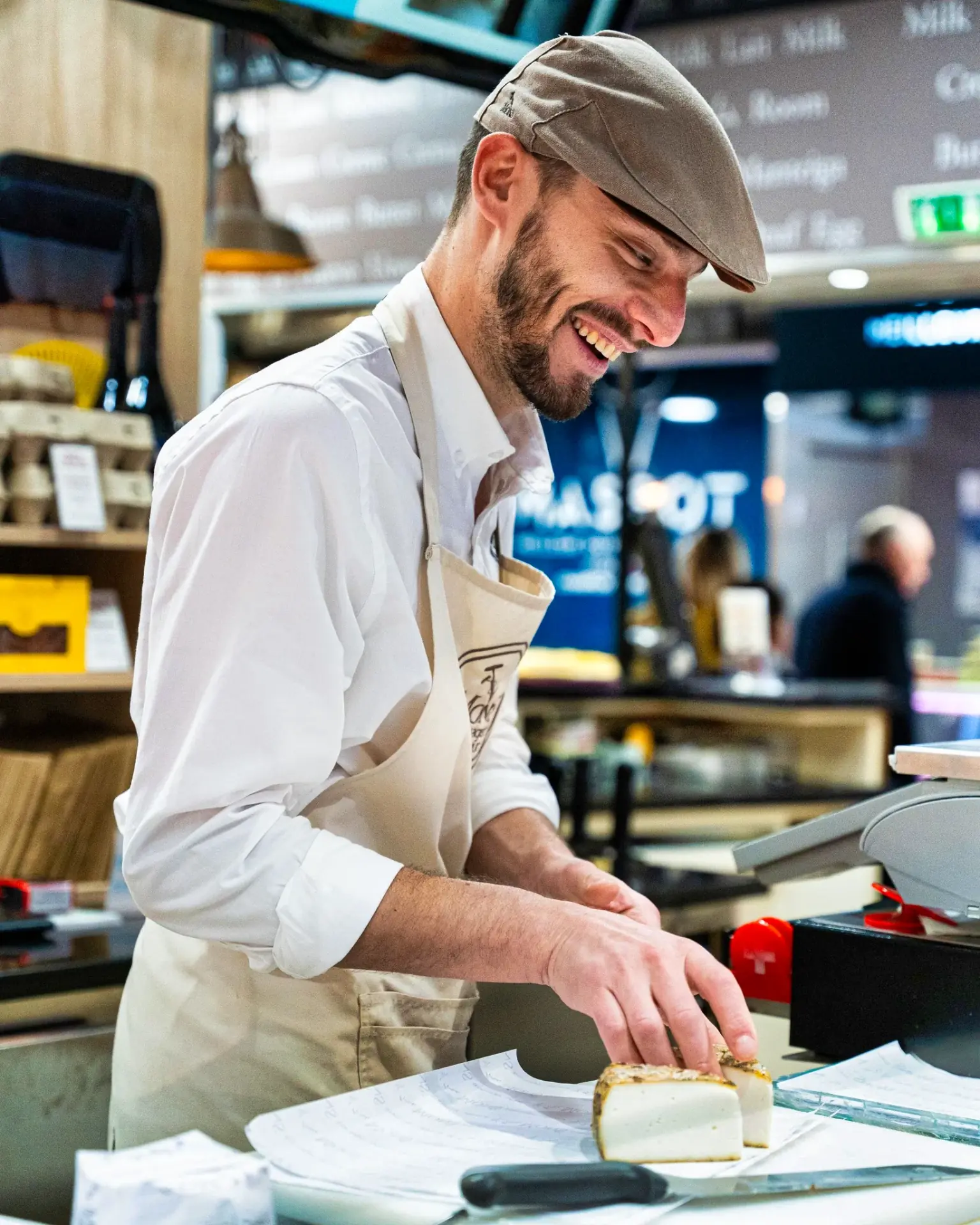
Behind every stall at Les Halles de Lyon Paul Bocuse stands an expert hand. It is this patient know-how, passed down and defended day after day, that makes the heart of the "belly of Lyon" beat.
People come to Les Halles de Lyon Paul Bocuse for the produce; they return for the gestures. Since the covered market opened in 1971, around fifty merchants and artisans have shared the 13,500 m² of the institution, each a master of a trade often learned from their own family. Cheese affineurs, charcutiers, oyster shuckers, butchers, pastry chefs, wine merchants: beneath a single glass roof gathers a rare concentration of talent, the direct heir to the exacting standards embodied by Paul Bocuse.
This savoir-faire cannot be decreed; it is handed down. In the ageing cellars, a cheese is turned, brushed and tasted for weeks before it earns its place on the stall. At the block, the cut is a science of muscle and patience. Behind the oyster counter, the gesture that opens a shell takes a second yet sums up years of apprenticeship. Nothing here is left to chance: everything springs from a craft held in honour.
This excellence has its titles of nobility. The Halles are among the rare places to bring together under one roof several Meilleurs Ouvriers de France, the state competition born in 1924 that Paul Bocuse, a laureate in cuisine in 1961, cherished above all. The blue-white-red collar glimpsed between the aisles speaks, better than any speech, of the highest degree of French artisanal mastery.
That they were named the third best market in the world by Food & Wine magazine is therefore no accident. The distinction salutes less a setting than a loyalty: that of artisans who, every morning, choose the perfect gesture, the right product, the honest word of advice. To push open the doors of the Halles is to enter a living workshop where savoir-faire, more than ever, remains a soul.